Silence Is the Bar Doing Its Job
Most trading tools are built to interrupt you, because attention is what they are optimized against. Here is the opposite design: the honest frequency of every pick grade, and the mechanics that keep the inbox empty.
Open any trading app and count what is asking for your attention. A badge on the tab. A push about a ticker you looked at once in March. A daily digest of movers you never requested. An email saying something is heating up, which is a sentence containing no information.
Very little of that is an accident, and none of it is really about you. Attention is the metric consumer software is optimized against, because attention is what keeps a subscription alive through the months it barely gets used. Notifications are the cheapest way to buy it.
The bill still comes due. It just does not arrive as a notification. It arrives as a fill: the trade you took on a Tuesday because an app told you something was happening, on a name you had no view on that morning, at a price you would never have paid if you had found it yourself. Nobody writes that down as the cost of their alert settings. That is exactly what it was.
An alert should be rare enough that its arrival is information
The design test we hold ourselves to fits in one sentence. A message is worth sending only if the fact that it arrived already tells you something.
If a notification fires every day, its arrival carries nothing. You have to open it to learn anything at all, which means the notification did no work; it only moved your attention around. If it fires once a month, the arrival is itself the content. You know something unusual cleared a hard threshold before you have read a word of it.
Most products cannot pass that test, because their alert volume is set by what keeps engagement healthy rather than by what the underlying thing actually does. Ours is set by the screen. Several times a day Optionator reads roughly eight thousand optionable stocks and ETFs, deletes almost all of them, and grades whatever survives. When the market does not produce something worth grading highly, there is nothing to send, so nothing sends.
A bar you clear every day is not a bar.
Hospitals already ran this experiment
The clearest evidence that noisy alerts fail on their own terms does not come from finance. In April 2013 The Joint Commission published Sentinel Event Alert 50, on medical device alarm safety in hospitals, and the number in it is the one worth carrying around: an estimated 85 to 99 percent of alarm signals do not require clinical intervention.
The consequence was not heightened vigilance. It was the opposite. Staff turned alarms down, switched them off, or simply stopped registering them, and the Alert documents patients harmed by alarms that fired correctly into rooms that had stopped listening. The phenomenon has a name, alarm fatigue, and the recommended fix was never a louder alarm. It was fewer of them, with the thresholds set properly.
Trading software is not a cardiac monitor, and nobody is harmed by a push notification. But the mechanism transfers exactly. A channel that cries wolf gets ignored, and it gets ignored on the one day it was right.
The honest frequencies
This is the part most tools will not put in writing, so here it is in writing. Every number below is a frequency, not a performance claim. Each one is a promise about how high the bar sits and says nothing whatsoever about whether a given pick works out.

Prime Position
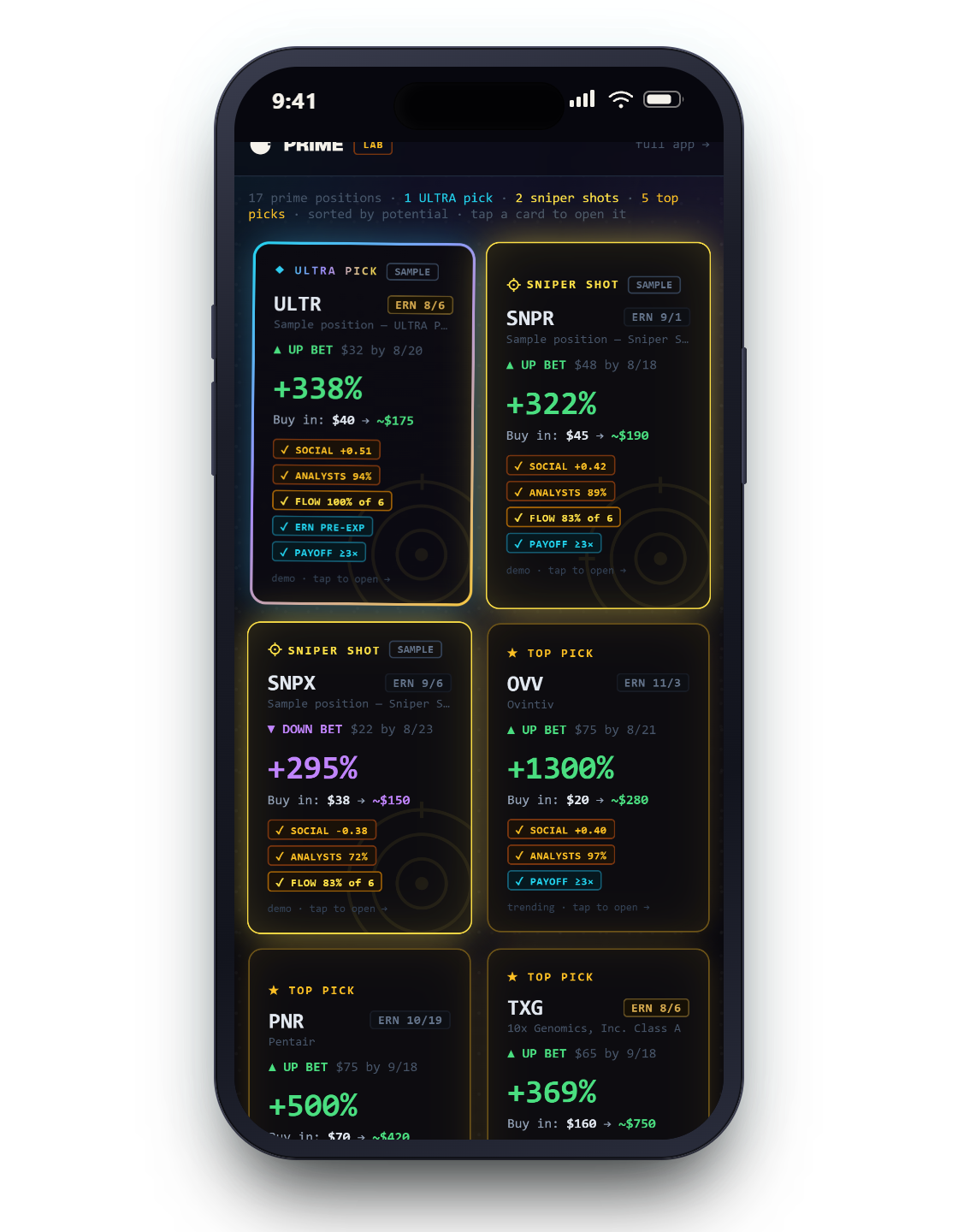
Survived the whole-market screen. Always something here, because this is the output of the scan rather than a judgment on top of it.
5 to 15 live at any time

★ Top Pick
Social sentiment and analyst consensus both lean the same way as the bet. Two independent crowds, one direction.
A handful on most days

⌖ Sniper Shot
A Top Pick where the unusual options flow agrees too. Now three sources point the same way.
A few in a good week, sometimes none

◆ Ultra Pick
A Sniper Shot carrying a payoff of at least 3x: the most asymmetric bets the screen finds. When an earnings report lands before expiration, it shows as a bonus catalyst flag.
Rare. Often one or two a week, sometimes none
Read the ladder as a stack of agreements rather than a stack of quality ratings. Each grade is the one below it plus one more independent source pointing the same way, and agreement of that kind cannot be scheduled. Some weeks the market hands over three. More weeks it hands over none.
Publishing those frequencies in advance is mostly a discipline for us. Once the expected rate is written down in public, the first quiet month becomes a normal outcome instead of a reason to quietly loosen a threshold.
How the quiet gets enforced
Philosophy is easy to write and easy to abandon later, so the restraint is built as mechanics rather than intentions.
Per-grade toggles. Alerts are configured by grade, not by volume. You decide which rungs of the ladder are allowed to reach you at all. Someone who only ever wants the rarest thing switches off the three grades beneath it and hears from us a handful of times a year, on purpose.
A hard daily cap. In Notifications you set a maximum number of emails per day: one, three, five, or unlimited. It is enforced server side, before anything is sent. When more picks qualify than the cap allows, the rarest grades go out first, because the scarcer signal is the more informative one.
The Alert Inbox. Everything the cap suppressed is still written to your account, in full, in order. Nothing is lost when a cap trims a busy day; it simply does not interrupt you. That distinction is the one most notification settings collapse. Not sending and not recording are different decisions, and only the first one is anything you actually wanted.
Ultra only, by default, on the free tier. Signals subscribers are opted in to the rarest grade and nothing else. The default that grows an email list fastest is the loudest available default. We did not choose it.
Why Signals is 15 full reveals, then redacted
A free tier built on rare alerts has an obvious shape problem. The alerts are the product. Give them away forever and there is nothing left to sell. Gate them on day one and nobody can tell whether the bar is real or just marketing about scarcity.
So Signals is shaped around the only thing that settles that question. Your first 15 Ultra Picks arrive in full: ticker, contract, strike, expiration, buy-in, potential. Not a teaser, not a blurred card, not a summary with the number removed. The real thing, fifteen times, at the real rate it fires. After that the alerts keep arriving and the specifics are redacted, with an upgrade prompt where the contract used to be.
Fifteen of a genuinely rare event is a long window, and that is the point. It is enough time to watch how often the bar gets cleared, what kind of setups clear it, and what tends to happen next. If the whole thing were noise dressed up as scarcity, fifteen full reveals would be more than enough rope for us to hang ourselves with. We would rather be judged on that than on a screenshot of a winner.
The part that belongs in every post about alerts
Optionator finds contracts and grades them. It does not tell you to buy anything, and it has no idea what is in your account. A quiet inbox is not a market call, and a loud one is not permission.
These are cheap out-of-the-money options. The same asymmetry that makes them worth screening for is what makes them expire worthless, and plenty of them will. Max loss on any position is your buy-in, which is exactly why the buy-ins are small, and exactly why you should never size one with money you need back. This is a screening and research tool, not financial advice, and no grade on the ladder is a promise.
Start with Signals. It costs nothing, and the first quiet week will teach you more about the product than anything above.