Options Screeners Compared: What They Add, What We Delete
An honest look at three options tools retail traders actually use, what each one is genuinely best at, roughly what it costs, and where a screener built to delete belongs instead.
The question that brings most people to a page like this is a shopping question: which options screener should I actually pay for?
It deserves a straight answer, including the version where you pay somebody else. So: three tools a retail options trader would genuinely consider, what each is good at, roughly what it costs, and who it is built for. Then where Optionator fits, and where it does not.
A note on the numbers
Everything below about another company comes from that company’s own site, read on 28 July 2026. Pricing moves and feature lists get reshuffled, so treat it as a dated snapshot and check the source before you buy. The descriptions are ours; the facts are theirs.
The data table
Barchart is the closest thing retail markets have to a public reference desk. Its options work sits in the top membership tier. As of July 2026 it lists three levels: a free tier at $0, Plus at $9.99 a month, and Premier at $29.95 a month. Premier carries the options tools, and the list is deep: advanced options screeners, unusual options activity, options flow, options time and sales, equity options price history, and unlimited custom screeners where Plus caps you at ten.
Barchart’s own help center states the idea plainly: you create your own options screener to narrow down puts or calls for stocks, ETFs or indices using the criteria you select.
That is the entire philosophy, and it is a good one. Barchart hands you the criteria and gets out of the way. If you already know what a good contract looks like to you, down to the delta band and the open interest floor, thirty dollars a month buys a lot of faithful machinery, and the exports mean your screen can feed a spreadsheet you own.
Built for: the trader who has a thesis about what qualifies and wants it applied across the whole market, exactly as specified, forever.
The strategy canvas
OptionStrat calls itself, on its own homepage, the next-generation options profit calculator and flow analyzer, and the first half is where it shines. The Strategy Builder covers more than fifty pre-made structures and lets you assemble your own, drawing the payoff curve as you go. The Optimizer inverts the question: give it a target price and a date, and it looks for the trade that expresses that view best.
As of July 2026 there is a free tier with delayed data and limited access, Live Tools at $39.99 a month, which carries net greeks for multi-leg positions and chance-of-profit math, and Live Flow at $99.99 a month. Both paid tiers advertise a seven day trial, and annual billing is listed as saving twelve percent.
If you trade spreads, condors or calendars, this is the right shape of tool. Grading a single contract does not help when the question is whether the short leg sits in the right place, and a payoff diagram you can drag is the correct interface for that.
Built for: the trader whose unit of thought is a structure, not a contract.
The flow feed
Unusual Whales built its name on watching the tape. Its own pricing page describes the core product as a live options flow feed with alerts, carrying real time trade data for every options trade across all US exchanges, with dark pool data and market analysis tools around it.
Pricing is split by product, which is worth knowing before you subscribe: the dashboard and the API are separate subscriptions, with a bundle for both. As of July 2026 the platform ladder runs Retail Basic at $50 a month, Retail Pro at $75, Retail Max at $120, and Professional at $200, with annual billing taking roughly fifteen percent off each, alongside a free account tier. Basic includes real-time flow, greeks and volatility dashboards, twenty five custom alerts and five watchlists.
There is a real edge in a fast tape, and a real community around reading one. If that is how you want to trade, this is the best known place to do it.
Built for: the trader who wants to watch, all day, and decide live.
What all three have in common
None of that is a knock. Each tool is very good at what it set out to do, and for plenty of people one of them is simply the correct purchase.
But notice the shape of the output. A screener hands you a longer table. A builder hands you a bigger canvas. A feed hands you a faster river. Every one is designed to show you more, and the better each gets at its job, the more it shows you.
Which means the last step is always yours. You still sit down at the open, on your phone, with twenty minutes, and delete.
All three are excellent at adding. Somebody still has to do the subtracting.
What Optionator does instead
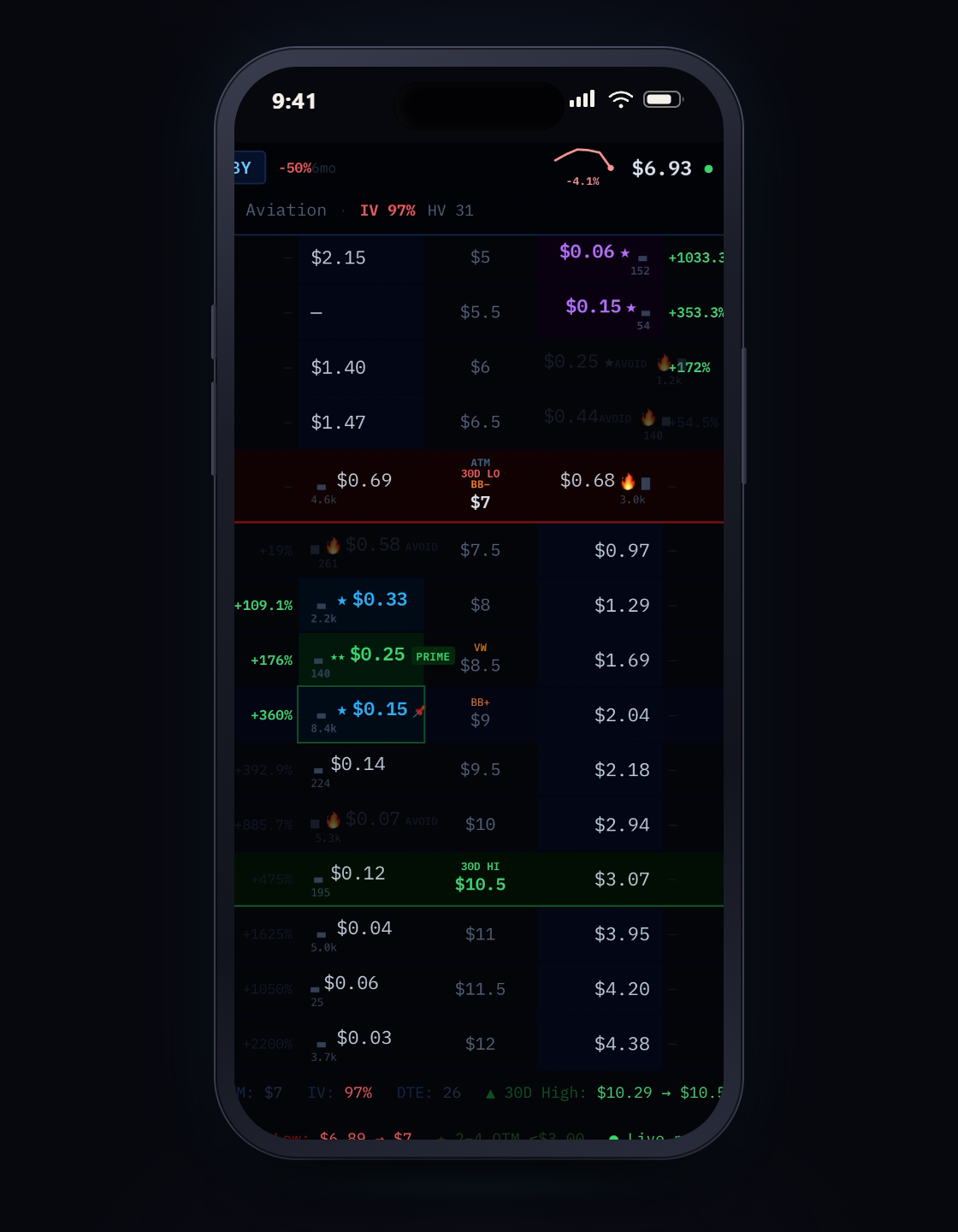
Several times a day Optionator reads roughly eight thousand optionable stocks and ETFs and deletes almost all of them. Five passes: volatility regime, directional setup, chain quality, affordability, profitability. What survives is 5 to 15 prime positions, one contract per name, out of the money and cheap enough to actually buy.
Two of those passes are the ones general screeners rarely apply, because they are opinions rather than data fields. Affordability: buy-ins routinely under $300, sized for a $2,000 to $10,000 account. Profitability: a clean move in your favor has to pay 200 to 500%, not twelve percent.
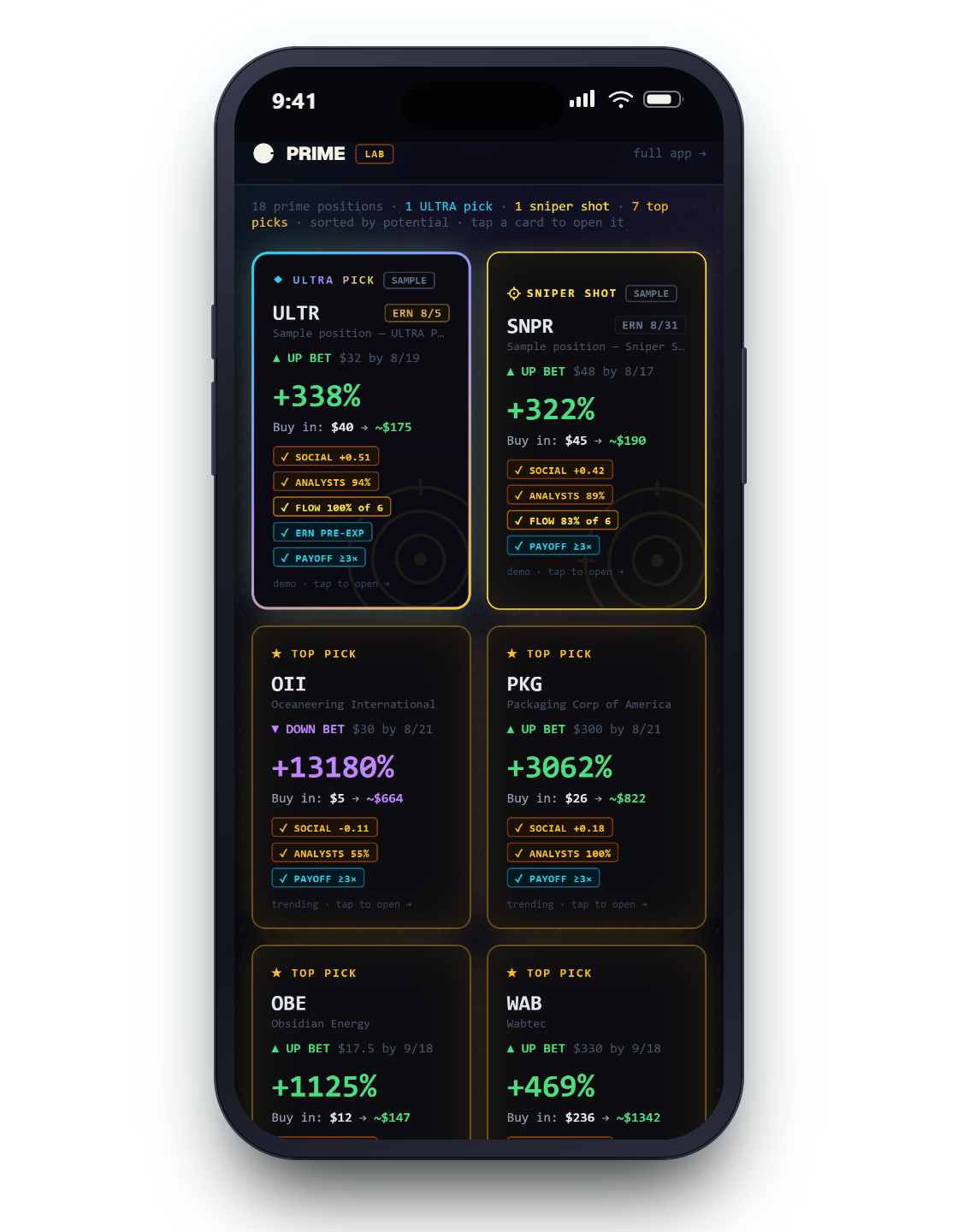
Then every survivor is graded live on one question: how many independent sources agree with this bet right now?

Prime Position
Survived the whole-market screen.
5 to 15 live at any time

★ Top Pick
Social sentiment and analyst consensus both lean the same way as the bet.
A handful on most days

⌖ Sniper Shot
The unusual options flow agrees too.
A few in a good week, sometimes none

◆ Ultra Pick
All of the above, plus a 3x payoff. An earnings report before expiration shows as a bonus catalyst flag.
Rare. Often one or two a week, sometimes none
Most days nothing near the top of that ladder fires, and that is the product working rather than failing. A bar you clear every day is not a bar.
Pick the right tool
Some honest routing, because the wrong purchase is worse than no purchase.
Use a strategy builder if you trade multi-leg structures, where the payoff shape is the decision. Optionator grades one contract at a time and will not help you place a short leg.
Use a flow feed if you want the live tape and have the hours to sit with it. Optionator reads flow, but only as one input into a grade, and never streams it.
Use a build-your-own screener if you already trust your own criteria and want them applied literally and cheaply. Barchart Premier at $29.95 a month is a lot of machinery for the money.
Use a broker platform if what you want is portfolio analytics, tax lots and order routing. None of these tools, ours included, try to be that.
Use Optionator if you run a small account with a few positions at a time, you want cheap out-of-the-money asymmetry, you do not want to maintain a screen yourself, and you can accept a quiet week without deciding the tool is broken.
They are not mutually exclusive either. Plenty of people will keep a flow feed open and still want something that hands them a short list at 6:45 in the morning.
What it costs
Signals is $0, no card and no account, and Ultra Picks arrive as they fire, the first 15 in full. Scout is $20 a month and turns on every grade, with per-grade toggles, a daily cap, the Prime Lab and the Alert Inbox. Full Access is $98 a month plus AI usage: live chains, the full screener, a 15-section research dossier per ticker, and hourly watchlist screening.
The part that belongs in every comparison
Optionator finds contracts and grades them. It does not tell you to buy anything, and it has no idea what is in your account.
These are cheap out-of-the-money options. The same asymmetry that makes them worth screening for is what makes them expire worthless, and plenty of them will. Max loss on any position is your buy-in, which is exactly why the buy-ins are small, and exactly why you should never size one with money you need back. This is a screening and research tool, not financial advice, and no grade on the ladder is a promise.
Still deciding? Start with Signals. It costs nothing, and the first quiet week will tell you more about whether this is your kind of tool than any comparison table could.