Introducing Optionator: The Screener That Deletes
Optionator reads the whole US options market several times a day and deletes almost all of it, down to 5 to 15 graded prime positions. Here is how it works.

Most screeners run on the same instinct: find more. Add a filter, add a column, add a tab. The output always has the same shape, a longer list, and the actual work, deciding what matters, gets handed back to you.
Optionator was built on the opposite instinct.
More is not a feature
Open any options screener and set your filters honestly. Liquidity, delta, days to expiration, IV rank. You get back four hundred contracts. Tighten it and you get eighty. Tighten it again and you have started curve-fitting to whatever you already believed before you sat down.
That list is not research. It is a to-do list you did not ask for, and every tool on the market keeps making it longer as it gets smarter. Better data, more sources, richer dashboards, same problem: you still have to do the deleting, at the open, on your phone, before the day gets away from you.
Deleting is the hard part. So we made it the product.
What Optionator actually does
Several times a day, Optionator reads the entire US options market. Roughly eight thousand optionable stocks and ETFs go in. Every one of them runs the same five passes: volatility regime, directional setup, chain quality, affordability, profitability.
Almost nothing survives. What comes out the other side is 5 to 15 prime positions: one contract per stock, out of the money, cheap enough to actually buy, on a name that is already moving and volatile enough to keep moving.
Two of those passes do most of the deleting, and they are the two that most screeners never apply at all.
Affordability. If a contract does not fit a real retail account, it does not belong on the list. Buy-ins are routinely under $300. This is built for the $2,000 to $10,000 account running a few positions at a time, not for a desk that can wear a $4,000 debit without blinking.
Profitability. A contract only survives if a clean directional move in your favor would pay 200 to 500%. Not a twelve percent grind. The asymmetric kind: ten contracts at forty cents that are worth a dollar sixty if the thing actually goes.
Then the number gets presented the way you already think about it. No greeks, no payoff diagram. Cost, then potential, in plain English: what you put in, what a clean move gives back.
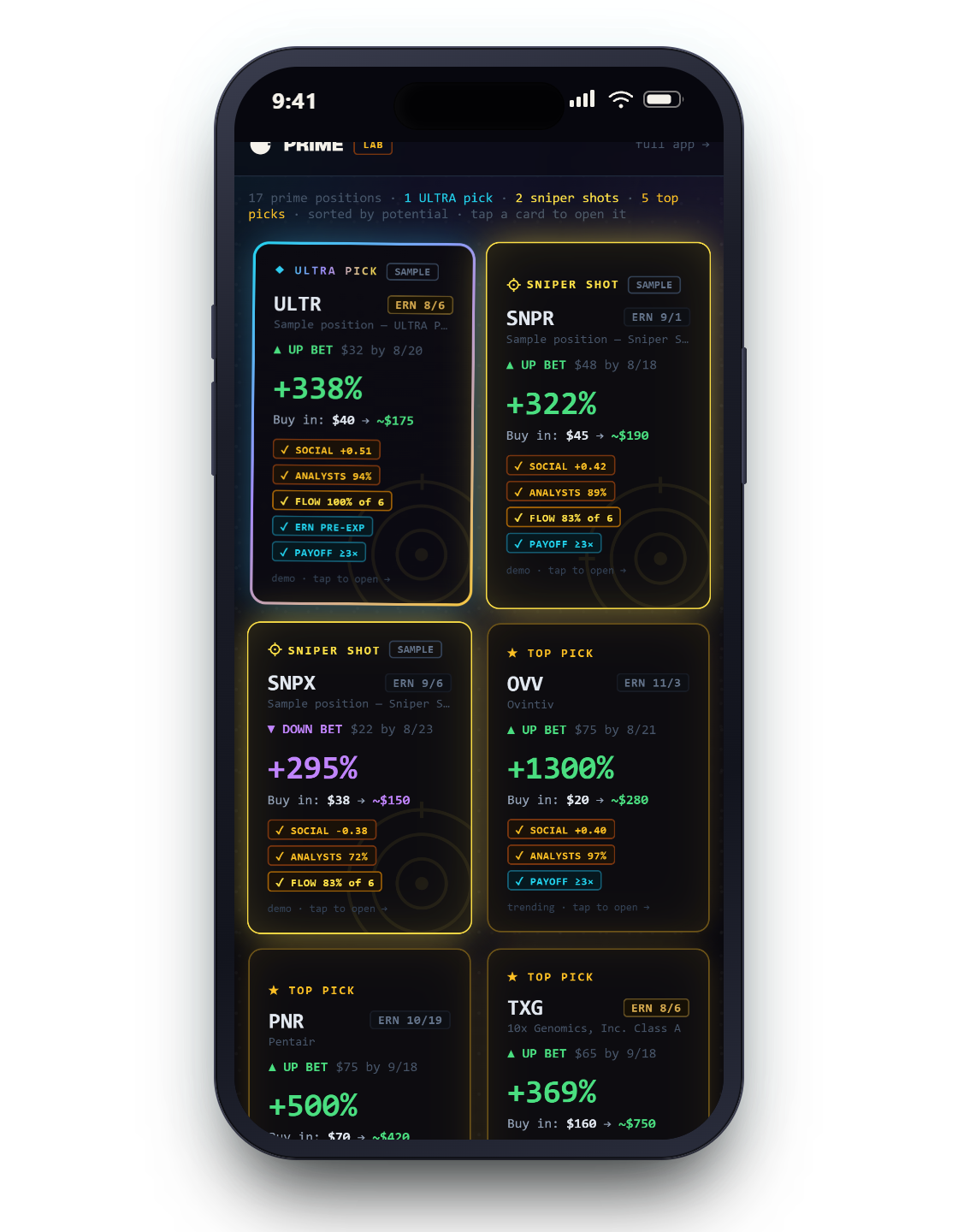
Four grades, one bar
Surviving the screen makes a contract a prime position. It does not make it a good bet. So every prime is graded live, and the grade answers one question: how many independent sources agree with this bet right now?

Prime Position
Survived the whole-market screen. A cheap out-of-the-money contract on a stock with a real directional move behind it and the volatility to finish one.
5 to 15 live at any time

★ Top Pick
A prime position where social sentiment and analyst consensus both lean the same way as the bet. Two independent crowds, one direction.
A handful on most days

⌖ Sniper Shot
A Top Pick where the unusual options flow agrees too. Big money is buying the same direction you are, and paying up for it.
A few in a good week, sometimes none

◆ Ultra Pick
A Sniper Shot carrying a payoff of at least 3x: the most asymmetric bets the screen finds. When an earnings report lands before expiration, it shows as a bonus catalyst flag.
Rare. Often one or two a week, sometimes none
Notice the shape of it. Each grade is the one below it plus one more independent source saying the same thing. That is why the ladder narrows as it climbs, and why the top of it is not something anyone can schedule.
Silence is the bar doing its job
Here is the part that makes this a strange product to sell.
Most days, you will hear nothing from us.
That is not the tool failing. That is the tool working. A bar you clear every day is not a bar. If an Ultra Pick landed in your inbox every morning, the only honest reading would be that we lowered it, and you would be right to stop opening them.
So we would rather be quiet and be worth trusting when something does fire. No feed you scroll gets shorter as it gets smarter. This one does.
How to start
Signals is free. No card, no account, nothing to cancel. Leave an email and the Ultra Picks come to you as they fire. Your first 15 arrive in full: ticker, contract, strike, expiration, buy-in, potential. After that they arrive redacted, which is the honest shape of a free tier.
Scout is $20 a month. Every grade turns on, not just Ultra, with per-grade toggles and a daily cap so you decide how loud it gets. It also opens the Prime Lab: every live prime in one screen, ranked by grade, each card flipping to a 30-day chart with your strike drawn on it. The Alert Inbox keeps the full history. The Demo Zone comes with it, which is the same picks rendered as a card deck, a radar sweep, a slot machine, a scratch ticket, and a vault you have to crack open.
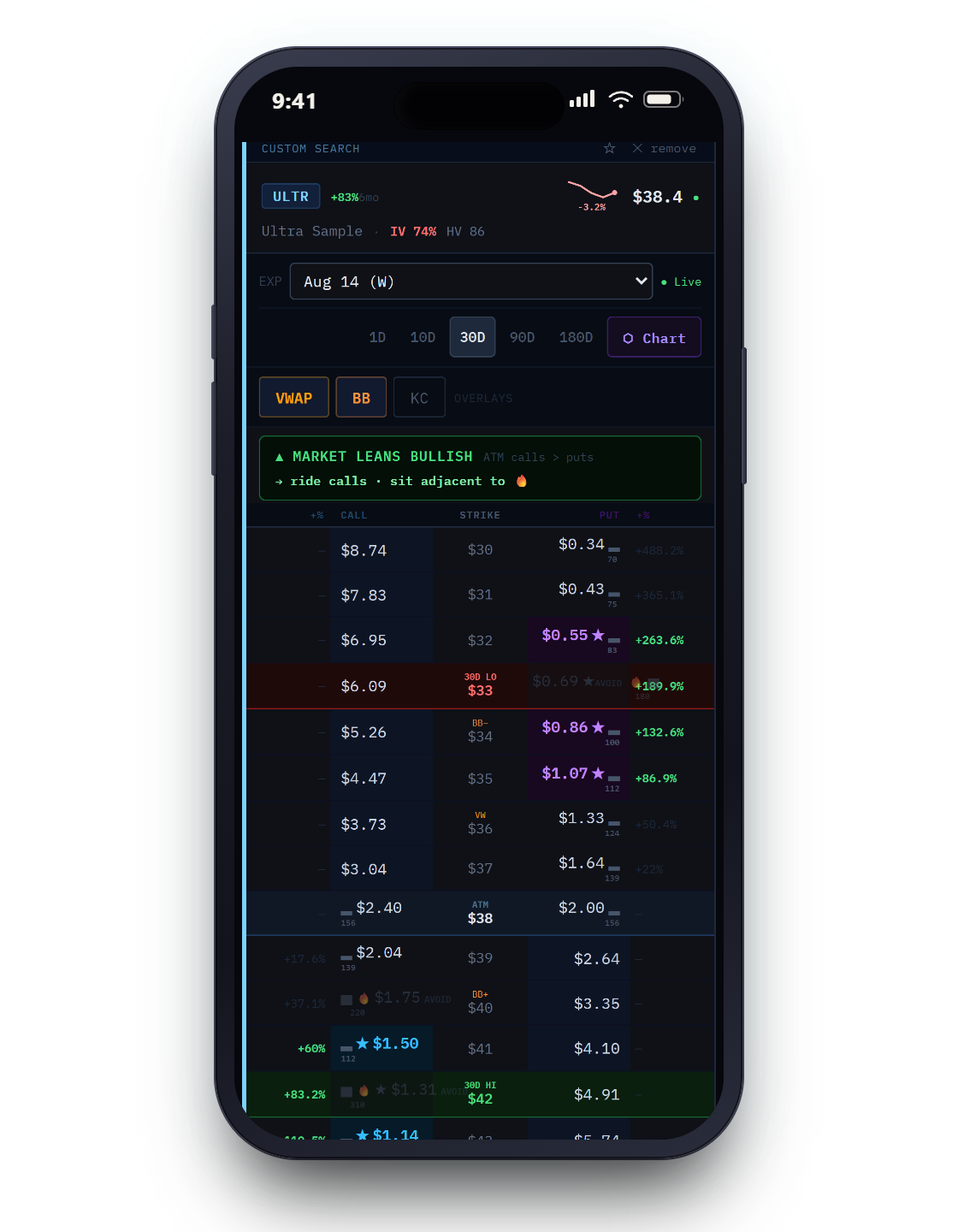
Full Access is $98 a month plus AI usage. That is the whole research desk. Live chains with real strikes, target zones and volume heat. The full screener across every profile. A 15-section research dossier on any ticker, covering company, earnings, news, socials, analysts, unusual flow, insiders and congress. AI Explore for the ecosystem around a name. And a watchlist that runs through its own screening profile every hour.
Invite codes still exist. If somebody hands you one, use it. Invited accounts sign up at Exclusive rates, which price the metered AI usage below the public rate.
The part that belongs in every launch post
Optionator finds contracts and grades them. It does not tell you to buy them, and it has no idea what is in your account.
These are cheap out-of-the-money options. The same asymmetry that makes them worth screening for is what makes them expire worthless, and plenty of them will. Max loss on any position here is your buy-in, which is exactly why the buy-ins are small, and exactly why you should never size one with money you need back.
This is a screening and research tool, not financial advice, and no grade on this ladder is a promise. The bar is real. What you do past it is yours.
Start with Signals. It costs nothing, and the first week your inbox stays quiet you will understand the whole product.